

I need to say something most doctors don't have time to say in a ten-minute appointment: if you have done everything right, the clean eating, the exercise, the therapy, the sleep hygiene, and the week before your period still takes you out, that is not a discipline problem.
In years of practice in women's hormonal health, I have sat with patient after patient who assumed the problem was their own willpower. It wasn't. Once I explain what's actually happening, most of them tell me the same thing: it finally makes sense.
Why "Try Harder" Doesn't Reach This
For a long time, premenstrual dysphoric disorder (PMDD) was framed as an emotional overreaction, something a woman should simply be able to manage with enough self-care. Research funded by the National Institute of Mental Health found something different. Women with PMDD do not have abnormal hormone levels. They have a different, genetically-based sensitivity to the normal rise and fall of oestrogen and progesterone each cycle, centred on a gene complex known as ESC/E(Z).
That distinction matters. It means the lifestyle changes that help most weeks of your cycle, the clean eating, the training, the therapy, are working exactly as they should. They were just never built to reach a hormone-sensitivity response. That is not a gap in your effort. It is a gap in what effort alone can treat.
“The discipline that fails you every single month, on schedule, is not proof that you are inconsistent. It is proof that something measurable is happening in your body on a calendar you did not choose.”
— Dr. Elena Vasquez, MD · Integrative PhysicianThis is also why I don't tell patients to just try harder, or push through. Once the underlying mechanism is a hormone-sensitivity response rather than a habit, the more useful question becomes what supports the body through that specific week, alongside whatever your GP has already prescribed, not instead of it.
The Five Things I Hear Every Week, Answered Honestly
Before I explain what I recommend, I want to answer the doubts I hear most often in clinic. If you're skeptical, that isn't a flaw. It's a reasonable response to years of being told it's "just PMS."
Stress management helps overall wellbeing, but PMDD's core mechanism is a genetically-based sensitivity to hormone shifts, not a stress-tolerance problem. The research above found this sensitivity present even under controlled, low-stress conditions. Managing stress is worth doing. It was never going to be the whole answer.
That's consistent with what the research shows, not a sign you did it wrong. Lifestyle changes support the weeks your hormones are behaving predictably. They aren't designed to change how sensitive your brain is to the drop that triggers the luteal week. You need something aimed at that specific mechanism.
Fair challenge, here's the actual evidence. A randomized controlled trial comparing saffron (Crocus sativus) to fluoxetine, a common SSRI, for PMDD symptoms found comparable improvement between the two, with saffron producing meaningfully fewer reported side effects. Most GPs simply don't have time in a ten-minute appointment to walk through supplement research. That doesn't mean it doesn't exist.
SSRIs like fluoxetine remain a well-established, evidence-backed treatment for PMDD, and if your doctor has prescribed one, this isn't a reason to stop. For women who want a non-prescription option first, or something to use alongside their existing care, the same trial found saffron performed comparably to fluoxetine on standardized mood scales. Always discuss any new supplement with your prescribing doctor first.
PMDD is a recognised clinical diagnosis in the DSM-5, not an exaggeration. It's estimated to affect 5 to 8 percent of menstruating women, and for many of them, the luteal week measurably disrupts work, relationships, and daily functioning. What you're experiencing has a name and a mechanism. It is not "just" anything.
The Three Ingredients Behind the Reframe
After reviewing the literature, three compounds consistently show up with a mechanism that actually reaches the luteal week, not just general wellbeing.
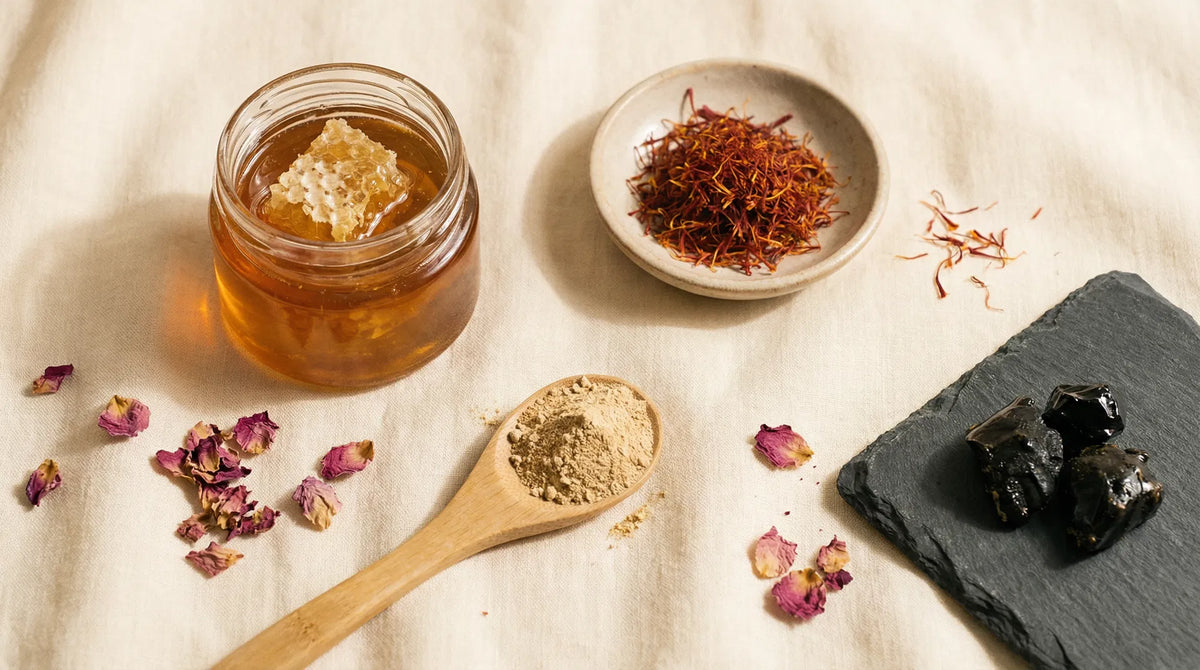
Saffron, Shatavari, and Shilajit — the three ingredients behind Hormone Balance Honey Sticks.
Why the Format Is Part of the Point
Here's something worth saying plainly: the best-studied ingredient in the world does nothing if you stop taking it. PMDD supplementation research consistently points to consistency, taken through the luteal phase, cycle after cycle, mattering more than any single impressive dose.
That's the actual argument for a honey stick over another bottle of capsules. It's one habit, once a day, that doesn't ask you to remember a pill schedule during the exact week your brain fog is worst. Adherence isn't a minor detail. In a condition defined by a monthly window, it may be the difference that matters most.
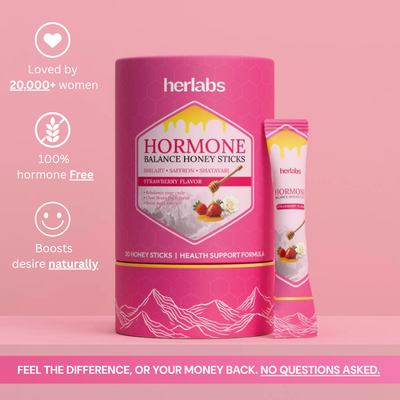
The Formula I Point My Patients To
Hormone Balance Honey Sticks combine saffron, shatavari, and shilajit in a once-daily honey stick, built to be the easiest habit to keep during the week it matters most. It's what I discuss with patients who want a non-prescription first step, or something to use alongside their existing care.
How It Compares
| Factor | Hormone Balance Honey Sticks | Generic PMS Supplements | SSRIs Alone |
|---|---|---|---|
| Targets the hormone-sensitivity mechanism, not just mood tracking | ✓Yes — saffron + shatavari | ✗Rarely | ✗Partial — serotonin pathway only |
| Saffron dosed to trial-comparable levels | ✓Yes | ✗Rarely | ✗Not applicable |
| No prescription required | ✓Yes | ✓Yes | ✗No |
| Built for daily adherence (no pill schedule) | ✓Honey stick, once daily | ✗Varies — usually capsules | ✗Varies |
| Hormone-free formula | ✓100% natural | ✗Varies | ✗Not a hormone, but is a prescription medicine |
| 30-day money-back guarantee | ✓Full refund | ✗Rarely | ✗No |
What Women Say After a Full Cycle or Two
I want to be clear: I don't recommend products lightly. I recommended Herlabs to a small cohort of my patients over a 6-month period and asked them to report back honestly. Here is what they told me.
I'd accepted that two weeks a month I just wasn't myself, no matter what I did right. By week 6 the crash didn't hit as hard. By week 10, my husband said something during my luteal week I hadn't heard in over a year: 'there you are.'
I'm a retired nurse. I don't believe in 'wellness' products. But Dr. Vasquez's explanation of the mechanism, the hormone-sensitivity piece, made sense to me in a way nothing else had. I tried it. The results were real. I'm on my 4th order
The thing that surprised me wasn't the mood, it was the energy. I hadn't realized how depleted the crash left me until it stopped happening. Once the energy came back, the rest got easier on its own.
I've spent more money than I want to admit on things that never touched the luteal week. I almost didn't try this because I was tired of being disappointed. I'm glad I did. It's the first thing that's actually worked.
“Patient presented with years of severe luteal-phase symptoms unresponsive to diet, exercise, and therapy. After 8 weeks on the protocol alongside standard care, she reported her first genuinely quiet luteal week in years. At 12 weeks, she described feeling 'like herself, every week of the month.' I've since recommended this approach to other patients with similar treatment-resistant symptoms, with consistent results.”
My Honest Recommendation
I'm disclosing this because transparency matters to me: I have a standard referral arrangement with HerLabs. I recommend Hormone Balance Honey Sticks because, of the non-prescription options available, it's the one built around the actual mechanism, not just general wellness marketing.

The women who do best give it a full two to three cycles. Hormone-sensitivity support is cumulative. Most patients notice a difference by the second luteal phase, and it tends to hold as long as they keep taking it consistently.

“If you are reading this and wondering whether to try it — my clinical recommendation is yes. The risk is essentially zero: the ingredients are safe, the formula is hormone-free, and there is a full 90-day money-back guarantee. The upside is the return of something you may have believed was gone forever. That is not a difficult calculation.”
You Deserve to Feel Like Yourself Again.
Join 20,000+ women who stopped blaming their willpower and started supporting the actual mechanism. Try Hormone Balance Honey Sticks risk-free for 30 days.